
In India
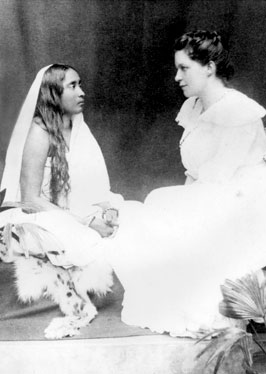 Shortly after arriving in India in January 1898, Swami Vivekananda initiated Margaret into the vows of a Brahmacharini and gave her the name, Nivedita, the Dedicated One. Soon after, on what she called “The day of days” Nivedita met Sri Ramakrishna’s wife and spiritual equal, the Holy Mother, Sri Sarada Devi, who received her with motherly affection and delight, calling her Khooki, “Baby.” Holy Mother and Her household would later induct Nivedita into the life of the cloistered Hindu woman, its ritual observances, devotions, and meditation, sanctification of daily duties, simplicity, and peace. This training and Holy Mother’s acceptance made it possible for Nivedita, a European woman, to live among, serve, and interact with Indian women.
From her arrival in Kolkata (then, Calcutta) and for the next nine months, Nivedita, Josephine MacLeod, and Sara Bull – The “Trinity” as Vivekananda called them – had the immense boon of daily classes with Swamiji. He wanted his Western students to understand India in-depth, spiritually, historically, culturally, and socially. During their travels with Swamiji to northern India, these lessons became a painful field of resistance and combat for Nivedita, and served to break down her English conditioning, prejudice, and naivete. Only a truly dedicated disciple could undergo the reshaping that she did. It never occurred to her to withdraw her pledge to serve him and India. She later recalled of that difficult period:
“Long, long ago, Sri Ramakrishna had told his disciples that the day would come when his beloved ‘Noren’ would manifest his own great gift of bestowing knowledge with a touch. “That evening at Almora, I proved the truth of his prophecy. For alone, in meditation, I found myself gazing deep into an Infinite Good, to the recognition of which no egoistic reasoning had led me. I learnt, too, on the physical plane, the simple everyday reality of the experience related in the Hindu books on religious psychology. And I understood, for the first time, that the greatest teachers may destroy in us a personal relation only in order to bestow the Impersonal Vision in its place.” Nivedita, p. 48
After months of intensive studies with Vivekananda, Nivedita started her girls school along Indian lines in the Baghbazaar quarter of Kolkata, following Swamiji’s rule of teaching to the aspirations of the taught. Its early stages began with young girls and child widows, and eventually included married women. It is almost impossible to imagine today the immense hurdles of caste, race, and economics that had to be overcome. One of Nivedita’s students later described her perspective: “…Education,…is not the accumulation of external knowledge and power but the enhancement of our innate abilities through self-effort. The foundation of India’s education is sacrifice and love. Love is born out of sacrifice of selfish interests…Sacrifice is the only means for achieving success in worldly life, but that sacrifice should be completely free from any selfish motive. If, even unconsciously, one’s sacrifice is made with a sense of egoism or desire, that valuable effort is ground to dust.” Nivedita As I Saw Her, Sarabala Sarkar, p.13-4. The school continues to this day.